

The data speaks for itself: those who choose hydroponics drastically reduce water consumption , shorten growing cycles, and obtain significantly higher yields per square meter. But it's not all about cutting-edge technology; there are also small-scale, community-based, and educational initiatives that are bringing this practice closer to families. In this article, we review how the sector is changing and what lessons we can learn, with an eye toward a more resilient future.

Water savings and increased performance

One of the most significant advantages is water conservation. While traditional cultivation can use between 1.000 and 1.800 barrels of water per day, a recirculating hydroponic system consumes only 15 to 20 barrels per protected structure. This is not an isolated case: another study in Mendoza, Argentina, calculated a 65% reduction compared to conventional soil cultivation, and asserts that these systems can use only 30% to 40% of the water required by traditional greenhouse agriculture, and even 15% of what open-field cultivation uses. The key lies in recirculation and precise control of the nutrient solution.
Yields also skyrocket. In trials conducted by INTA, vertical farming achieved up to 14,5 kilograms per square meter of horizontal surface , which is more than 300% higher than a soil-grown crop in a greenhouse with efficient management. Furthermore, cycles are significantly shortened: hydroponic lettuce can be ready to harvest in just 22 days, while in open fields it takes between 50 and 55 days. This allows for greater production in less time and with fewer resources.

Climate technology and control
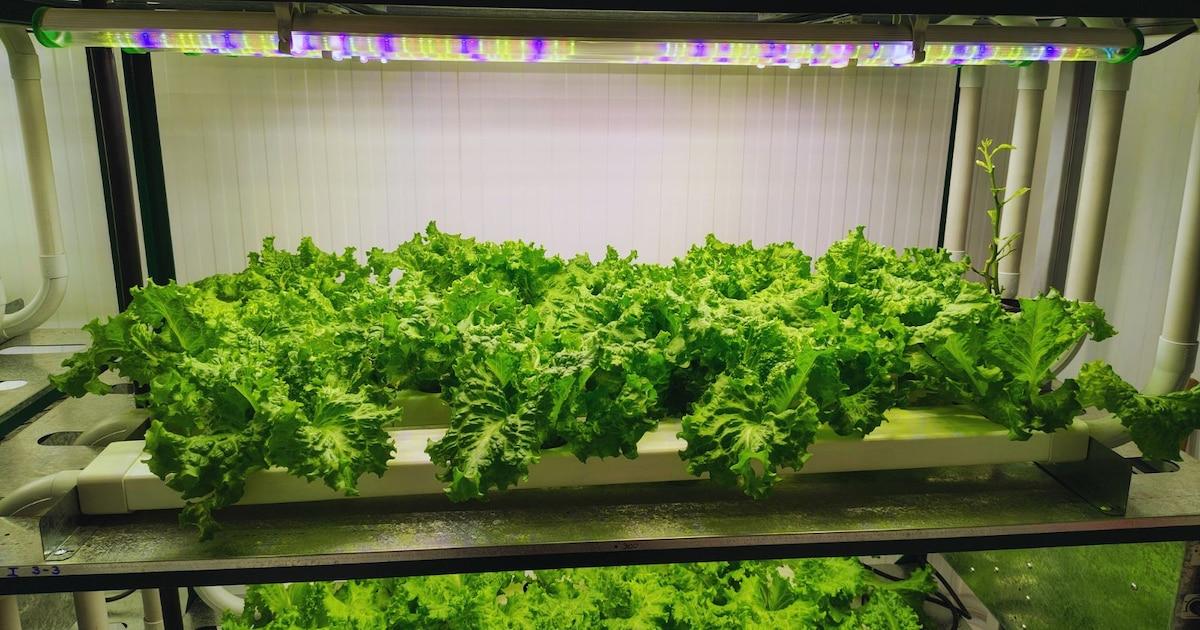
Behind these achievements lies a significant amount of technology. Modern greenhouses feature protected structures , ventilation systems, reservoirs, and recirculation mechanisms that optimize every drop of water. But one of the elements that has evolved the most is lighting: LED lighting is no longer limited to illumination, but has become a management tool . According to INTA (National Institute of Agricultural Technology), adjusting the light intensity can achieve yield increases of nearly 60%. Combined with proper fertigation, light allows for guiding the crop towards desired characteristics, both in flavor and nutritional value.
Environmental control opens the door to foods with differentiated properties , as it's possible to regulate temperature, humidity, nutrition, and photoperiod to enhance bioactive compounds. In regions where water or soil is a problem, such as arid or urban areas, this technology presents itself as a viable alternative for producing fresh food year-round. The initial investment is high, but the medium-term benefits seem to more than compensate, as noted by producers who have already taken the step.

Community and small-scale applications
It's not all about large-scale operations. Hydroponics is also reaching homes and communities. In Santa Cruz, Argentina, a program called Santa Cruz Puede has conducted demonstrations at children's fairs to teach kids how to germinate and transplant plants in raised beds. The idea is to show that anyone can have their own small hydroponic garden at home, with simple systems that adapt to limited spaces. Something similar is happening in Peru, where the San Isidro Hydroponics Association has received funding to build greenhouses and improve its local production.
These initiatives not only promote food production but also create social cohesion and employment . In one project in Honduras, a family business transitioned from traditional methods to combining soil cultivation with hydroponics, and today employs 18 people and benefits approximately 15 families. Furthermore, the produce is sold to supermarket chains, demonstrating that hydroponics can be integrated into the conventional commercial system. Aromatic herbs and lettuce are the flagship products, but they are already experimenting with tomatoes, chili peppers, and other vegetables.
Finally, we mustn't forget that hydroponics also has an educational and awareness-raising component. Teaching children that there are alternatives to traditional farming is the first step in building a more conscious and prepared generation to face environmental challenges. Because, while technology is important, the human factor remains the most valuable.
In short, hydroponics is establishing itself as a strategic tool for the agriculture of the future. Examples from various countries show that, with an initial investment and some training, it is possible to produce more with less water, in less space, and with shorter cycles. The combination of technology, knowledge, and community work is demonstrating that adapting to climate change is not only necessary but also an opportunity to reinvent the way we grow our food. It is clear that hydroponics is here to stay and that it has great potential for building a more sustainable and resilient food system.

Content of the article